Sunday, December 11, 2011

Pura Vida- Arenal

 "Soy Tico y si me asomo a la ventana me cautiva la montaña y se me alegra el corazón. (I am Tico if when I look out the window the mountain captivates me and warms my heart.) "- from "Soy Tico" by Carlos Guzman
December 1, 2011
Like aloha and shalom, pura vida is more than its simple translation of "pure life." Pura vida can be a greeting, a response to "How are you?," or an expression of contentment. In the context of Costa Rican culture, pura vida is a philosophy of life that embraces the richness of living and embodies a connection with the land.
I am not Tico, but I am fascinated and awed by the mountains that form the backbone of Costa Rica. Evidence of the power of tectonic activity, these are relatively young mountains. Located near La Fortuna, Arenal is estimated to be about 7000 years old. A stratovolcano, Arenal is composed of successive layers of ash, rock,and lava.  

After 400 years of inactivity, Arenal was presumed to be extinct. However, the subduction of the oceanic plate beneath the continental plate was slowly building up a pool of magma and pressure. In 1968, Arenal violently burst to life spewing rocks, ash, and lava into the valley below. The eruption killed 87 people and completely buried three small villages.  Evidence of the eruption is apparent in agricultural fields littered by boulder-size rocks called  lava bombs.
Seismic activity is monitored and hiking is permitted in the national park - at your own risk. Following our knowledgeable guide Eduardo Baldioceda, we walk along a flat smooth sandy path cut through tall waving sourcane. A trail maintenance worker responds to Eduardo's greeting with "pura vida." You can't help but smile when you say pura vida.

As we move along the trail, the peaty smell of the sourcane fields becomes more herbal and the vegetation more forest-like.  Tree limbs are homes to insects, ferns, epiphytes, and parasitic vines. At the base of the trees, lycopodia thrive. Looking like a forest of miniature pine trees, these clubmosses are among the most ancient of vascular plants and in the tropics are limited to mountain habitats.


Tubular flowers attract hummingbirds and butterflies who enter the flower for sweet nectar and carry away pollen. A few insects have an adaptation that allows them to pierce the tube of the flower and extract the nectar without assisting with pollination.
 The one-day orchid blooms and dies within a 24-hour period.  As we stopped to inspect these randomly dispersed beauties it is apparent that they are food for insects. A few have already begun to loose their petals to browsers.


Although the plants are diverse from the tiny lycopodia to enormous kapok tree, it is the Insects that are most abundant in number and variety. Ants are everywhere in the cecropia tree, marching along with leaves, and swarming like an army in a disorganized front of vicious biting soldiers. Mosquitos buzz exposed ears, necks, and arms in search of a meal. Dazzling jewel-like beetles cling to tree trunks. Butterflies dance through openings in the forest. 


Life and death in the forest occurs on a small scale- insect as predator and insect as prey. Bromeliads are plants that obtain moisture and nutrients from a reservoir at the top of the plant. Insects take advantage of this little pond for water and nutrients. The predatory wolf spider spins a web over the top of the reservoir. An unsuspecting insect stopping for nourishment can quickly become dinner. But there are the scavengers who outwit the predator. A thread-leg insect can walk on a spider's web and steal a spider's prey. Although at first the thread-leg insect looks like a spider, a leg count confirms that it is an insect. 


 A lahar snakes like a riverbed between the sourcane marking the place where a thick slurry of hot ash raged down the mountain slope. The pioneer species of the lahar, sourcane, grasses, and trees, gradually brought life back to the barren gray lahar. A thin layer of organic material is visible above the thick layer of ash and fine sandlike particles of rocks.


Root systems are shallow. It is not uncommon to walk past a toppled tree uprooted by wind and rain. Opportunistic organisms will decompose the tree drawing nutrients from its bark and core. What remains will enrich the soil increasing the fertility of the volcanic ash.


Beyond the lahar lies the lava field. Huge boulders and rocks of balsaltic Andesite are a testament to the explosive power of the 1968 eruption. Pioneer species of lichen and mosses have begun the slow biological process of breaking down the rock into soil. 
But the volcano is still alive. Natural hot springs are warmed by the volcano. Small quakes occur daily. Stand quietly and you can hear the volcano breathing and the low hum of a heartbeat as magma flows through its veins.


Arenal disappears into mists that veil the summit of the stratovolcano. The chance that the clouds might clear to reveal the symmetry of the cone is tantalizing. As the rainy season comes to an end, a burst of sunshine teasingly parts the clouds. The breeze whispers that if we could but linger here a little longer the clouds will lift and Arenal will be bathed in the rays of the morning sun.
The clouds descend again as we prepare to return to San Jose.  Ah, pura vida here in the mountains. Perhaps I am a little bit Tico.
Map source: http://www.costaricaguides.com/map_costa_rica_.html


More to Explore
The formation of the landmass known today as Central America was a major global climate change factor. Learn more about the tectonic activity 5 million years ago that closed ocean circulation between the modern Pacific Ocean and Atlantic Ocean.
Read "How the Isthmus of Panama Put Ice in the Arctic" at Oceanus.

Wednesday, December 7, 2011

Biodiversity-Preserving Native Species

“Loss of the world’s genetic diversity would be worse than energy depletion, economic collapse, limited nuclear war or conquest by a totalitarian government .As terrible as those catastrophes would be for us, they could be repaired in a few generations. The one process ongoing in the 1980’s that will take millions of years to correct is the loss of genetic and species diversity by the destruction of natural habitats. This is the folly our descendants are least likely to forgive us”. E.O Wilson


Tuesday, November 29, 2011
We are still at Sarapiqui. Today we are volunteering to either remove invasive plant species or transplant ornamental native species of plants. For a moment, this seems like a roadblock event choice on the "Amazing Race."
The sun has made a brief appearance and I am struck by two thoughts: my sunscreen is on the bus and I will have to cross another suspension bridge. The young biologist assigned to our group is adamant that I need to go back for sunscreen. I clearly am not from a warm tropical climate and need to figure out how to (1) not burst into flames in the sun and (2) not be mosquito bait. Decisions, decisions- should the sunscreen go under the insect repellent or over the insect repellent.
After a brief orientation to the two types of jobs we will be doing, I join the transplant team. Armed with a shovel, cart, and plant tags we set out to learn how to separate shoots from the mother plant. The tuberous roots are thick and difficult at times to sever, but we must be careful to remove enough of the roots that our transplants will take in a new location. 
Susan Tate, a grade 8 science teacher from Michigan with a specimen for transplantation.
The purpose of the project is to demonstrate how native plants can be used for ornamental landscaping instead of nonnative species. Too often nonnative landscaping plants become invasive or provide no benefit to the organisms in ecosystem. 
Heliconia flowers
The native tropical plants are attractive to the human eye and in many cases provide food, water, and shelter to birds and insects. One such plant is the heliconia. The cuplike flowers capture rainwater and produce a sweet nectar. Hummingbirds and insects are attracted to the bright red flowers and benefit from the water and food provided by the flowers. The plants in turn benefit from pollination. Berries of the heliconia are eaten by birds and the seeds are dispersed as digestive waste.
Our other team of teachers has the backbreaking task of removing coffee robustus plants, a crop plant that failed to be commercially viable. Without consumers or parasites or other natural curbs on growth, these plants have successfully crowded out native species. Moving in a deliberate path of destruction, the volunteer team painstakingly removes one plant at a time making sure that no root, shoot, or seed remains to regenerate.
The Ah-Ha Moment
As the transplant team waits for the invasive species removal team to return, I marvel at the leafcutter ants. Hour after hour, this highly organized society of ants travels along a well defined trail carrying leaf bits back the the nest. 
The ants will use the leaves to farm a fungus needed for nutrition. The leafcutter ant queen mates once and produces eggs as needed for up to 20 years. When she dies, the colony dies. A few survivors will harvest the fungus and move on to form a new learcutter colony.
The entire hill is one leafcutter ant colony with one queen and thousands of ants.
Watching the parade of ants, it occurs to me that this is the very place where E.O. Wilson began his research. This is the place that inspired his passion for preserving biodiversity. I am  now in this place marveling at the wondrous complexity of the biological systems just on a single tree.
I am struck by the realization that the biodiversity of a single tree in this forest far exceeds the diversity of an acre of suburban New Jersey. It was an ah-ha moment of why what we did today matters and why we need to find ways to preserve the natural habitats that remain back in our home states. I am inspired to find ways to engage students in this discovery.

Listen to E.O. Wilson talk about his early research at La Selva.
.
Read The Diversity of Life (Google Books)

Consider the following:
How is the "residency" status of a plant determined?

Tuesday, November 29, 2011

Biodiversity

Consider the following: "In the tropics, the common is rare, and the rare is common."


The Sarapiqui River drains the watershed from the highlands to the west to the Caribbean to the east. Normally the river rushes clear with rapids perfect for adventure sports. However, abnormally heavy rains have washed thick brown sediments out of the highlands. The river is higher than normal and chocolate brown. To reach the rain forest preserve at Tirimbina biological Reserve, we cross the Sarapiqui River on a suspension bridge.

The river cuts through the Tirimbina Biological Reserve that contains both primary and secondary growth rain forest. The differences between the two types of forests is apparent. The primary forest has a well developed canopy and only a few understory of plants that are adapted to capturing light with large leaves. A walk along the trail at the edge of this jungle is a step back to the Cretaceous period, except that the cycads and ferns are small while flowering plants and trees are tall. 
The understory of the secondary forest is dense with small trees and flowering plants. The canopy is lacy and open barely filtering light down to the highly populated understory.
What type of forest is shown in the image? Explain.

To avoid predation, plants produce alkaloids, powerful often fatal chemicals when ingested. Mutualistic and parasitic relationships have evolved over time. The cecropia tree is a great example. The trunk of the tree is hollow. Ants construct a colony inside the tree. The tree provides the ants a sugary sap, while the ants attack any animal that tries to eat the tree or any plant that attempts to compete with the tree. 
Notice the small holes  that ants use to enter and exit the trunk.
Listen to the sound of the hollow trunk.


To be continued.  We are leaving this morning for a service project.

Friday, November 25, 2011

Guayabo

From San Jose, we travelled toward the Caribbean side of Costa Rica. After visiting Blue Valley School, an upscale private pre-k through high school campus, we toured Guayabo National Monument. 
The monument is an archeological site revealing a culture that inhabited the region from approximately 1000 years B.C. to 1400 years A.D.  
The people constructed conical homes on circular mounds with the size and position of the home dependent on status within the tribe. The life expectancy appears to be about 40 years. The bodies of the dead were decomposed and the cleansed skeletons were buried inside the family mound under the house.
An impressive subterranean aqueduct captured and stored water that flowed to the village through an open aqueduct system. 
A roadway constructed of boulders without the invention of the wheel cuts through the modern forest, a reminder of the labor and engineering ability of an ancient people.
The American Society of Civil Engineers recognized Guayabo as a World Heritage Site in 2009.
We are currently at Earth University. It has rained since Wednesday. When it rains heavily, the Internet connection becomes intermittent. Tomorrow we depart for overnight homestays. I will be be updating the blog Tuesday, November 29.  The sun has appeared!  I need to run outside and try to dry the mud off my sneakers.  So for now, please enjoy the sounds of the rainforest from our Earth University balcony.

And now it's raining again.

Tuesday, November 22, 2011

More on San Jose

As we leave the central city of San Jose to visit the U.S. Embassy, the office buildings, government centers, and hotels yield to poor residential areas. Small single story homes are packed tightly together. Our guide recalls when it was normal to leave one's front door open. Today, however, windows and doors of homes are barred. Walls and fences are topped with razor wire and spikes.  As we continue to the embassy, high-rise construction projects (in Costa Rica 14 floors is a high-rise) mark a transition to a more affluent area. 
On the way back to San Jose we pass a new sports stadium donated by the People's Republic of China. The stadium is a modification of the Bird's Nest of the Beijing Olympics.
Collecting Weather Data
Today was a chance to collect weather samples. Air temperature, relative humidity, wind speed, and "feels like" data were collected using a handheld Kestrel weather station. An infrared thermometer was used to collect temperature data from the sidewalk and blacktop around the hotel. An RED pressure probe was used to collect air pressure data. Data was collected at the Aurola Holiday Inn in central San Jose.
The collection site is near the white column. The park is located directly across from the data collection site.
Sunrise 5:34 A.M.
Sunset 5:11 A.M
Data 8:30 A.M.
The sky was clear and sunny. Small cloud wisps are visible along the volcanic mountain tops.
  • Air temperature 23.3 degrees C
  • Relative humidity 59%
  • Feels like temperature 27 degrees C
  • Wind speed average 5.4 kph from the east
  • Air pressure 89.68 kPa (not adjusted to sea level)
  • Sidewalk temperature 38.6 degrees C
  • Blacktop temperature 31.6 degrees C
Data 3:00 P.M.
The sky iss overcast and a light rain is falling. Clouds rolled over the mountains during the early afternoon swallowing the peaks.
  • Air temperature 23.1 degrees C
  • Relative humidity 67.5%
  • Feels like temperature 23.6 degrees C
  • Wind speed average 2.7 kph from the southwest
  • Air pressure 89.29 kPa (not adjusted to sea level)
  • Sidewalk temperature 27.8 degrees C
  • Blacktop temperature 27.1 degrees C
Data as reported by San Jose (MORC) weather station.

Consider the Following
  • San Jose receives 12 hours of sunlight every day of the year. An afternoon rain shower is expected every day approximately 2 hours before sunset.. Why?
  • The elevation of San Jose is 931 meters. What would the atmospheric pressure be if it was adjusted to sea level?
  • Given the day length and cloud cover during the late afternoon would an urban heat island effect be likely in San Jose?

Monday, November 21, 2011

San Jose, Costa Rica

Our travel day begins with a 3:30 A.M. wake-up call. Our flight departs on-time at 7:15 A.M. from San Antonio to Houston where we immediately change planes for San Jose, Costa Rica. The total flying time was approximately 5 hours including the 30 minute connection at Houston. By mid-afternoon we checked into the Holiday Inn and ventured out on a guided tour of central San Jose.
San Jose is the capital of the province of San Jose. It is located in Costa Rica's central valley region and is surrounded by volcanic mountains. During the day, temperatures had been in the upper 70's (degrees F). However, but 3:00 P.M. a light rain fell for a brief period as we set out to explore central San Jose. A light wind continued until sunset around 5:45 P.M. and skies remained overcast. Temperatures dropped into the upper 60's (degrees F), but the air retained a humid feel. Long-sleeved shirts or light jackets were comfortable clothing.
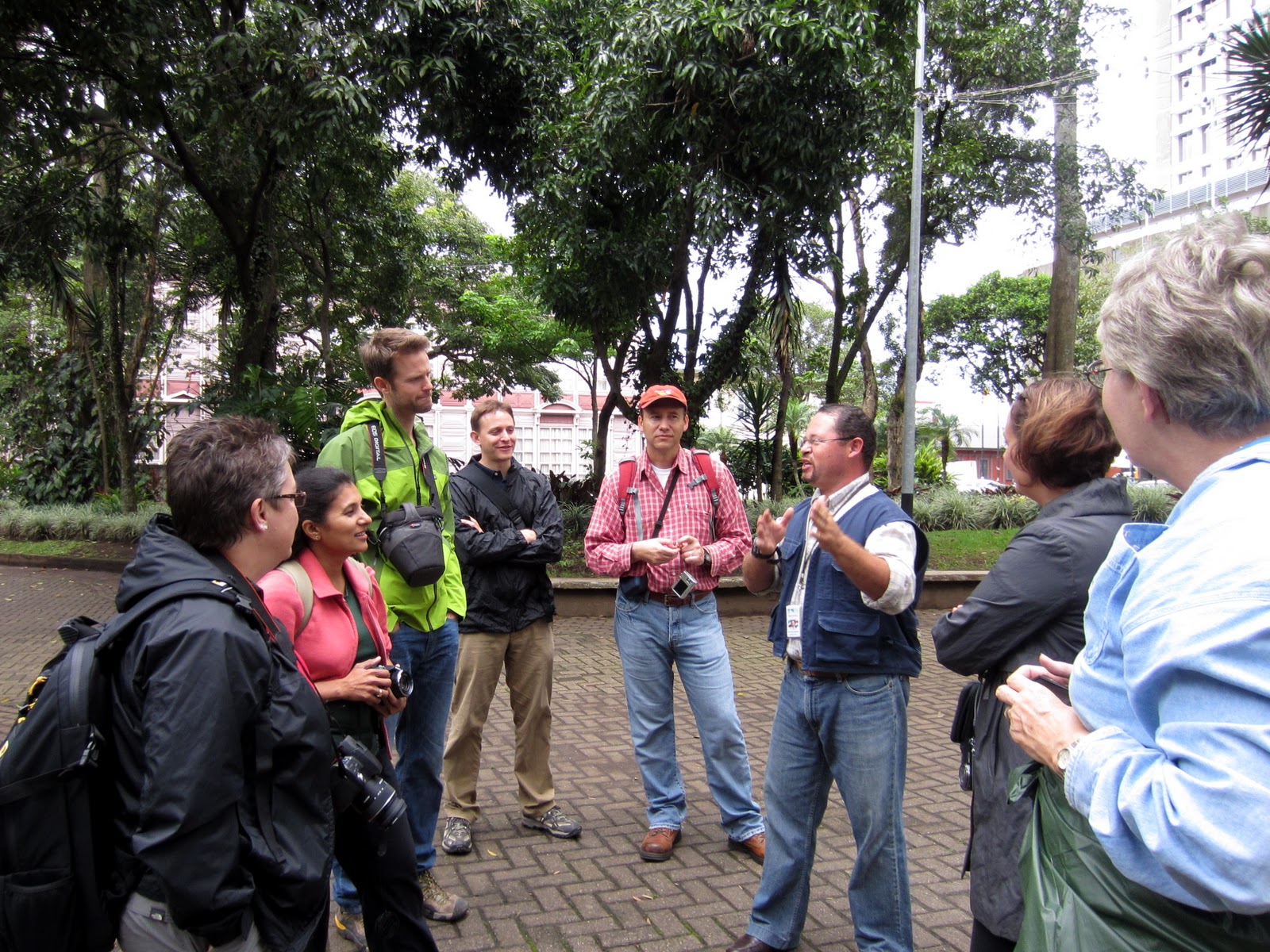
The "Leaf-Cutter Ant" group on a walking tour of San Jose with our local guide.
San Jose is largely a commercial area. There are no permanent residences in the city and no apartments. Homes are single family structures of one to two stories that are located in areas surrounding the city. San Jose experiences thousands of micro-quakes a day. Because of the seismic activity, all building in San Jose need to be earthquake resistant. The tallest building is in Costa Rica is in San Jose. It is 22 stories tall.
National Insurance Building
There are no buildings from the colonial period. Being a poor area, Costa Rica was the last region of Central America to be conquered and colonized by Europeans. Structures from the colonial period were constructed from adobe and disintegrated long ago. Spanish and French influence is apparent in the architecture of buildings that date from the 1800's.
The Yellow House built by Andrew Carnegie served as the home of Costa Rica's president and is now a judicial building.

These are not homes. They are business and government office buildings.
Although there are no green zones in San Jose, there are several small parks and trees line the streets.
The common name of this tree is inspired by the shape of the flower. Can you guess the name? (Hint: Think of what you would need to clean out a bottle.)
The color of the Bouganvilla flowers depends on the humidity of the soil.
Click to enlarge the picture. Can you find flower buds, flowers, and seeds all on the same plant at one time? This is the Yesterday-Today-Tomorrow plant. Why was it given that name?

Tomorrow more about San Jose. 

Saturday, November 19, 2011

Where am I today?

The afternoon was cloudy, but gave way to sunshine. The air away from the river and trees is warm and humid. Small green gardens and water features create a cooling effect. Barges filled with tourists navigate the river. The river walk is alive with diners, tourists, and shoppers. The Spanish influence is apparent in architecture, language, and the faces of people who call this place home. Tonight we will be taking a barge tour.
Bike sharing, an idea gaining popularity in Japan and the Netherlands is catching on here. Bikes are rented and returned at the bicycle station. Using a bike to travel in the city reduces carbon emissions and improves air quality.
Where am I?  (Hint: Richard Stockton from New Jersey died a hero here.)